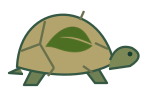
Getting to know the species
Egyptian tortoise
Testudo kleinmanni
Testudo kleinmanni: a small tortoise from the south-eastern Mediterranean, not part of Italy’s wild fauna. Understanding its habitat, biology and vulnerability is a way to protect it.

Egyptian tortoise · authentic photograph published by USFWS. It does not document a presence in Italy.
Photo: Thomas Leuteritz/USFWS — Egyptian Tortoise (U.S. Fish & Wildlife Service) · Public domain. Web copy resized and compressed, without cropping or retouching.
The Egyptian tortoise, Testudo kleinmanni, takes us to the other side of the Mediterranean. Small size does not mean a small commitment: understanding it begins with its landscape, not the desire to own it.
Another face of the Mediterranean
Its distribution covers Libya, Egypt and the western Negev. USFWS distinguishes the extensive historical range from today’s greatly reduced occurrence. The name ‘Egyptian’ does not mean it lives only in Egypt.
It is not a fourth wild tortoise species in Sardinia. Mediterranean origin does not make it native to Italy. For the island’s tortoises, begin with the Hermann’s, Greek and marginated tortoise feature.
What to look for in the photograph
The carapace is domed, in pale shades ranging from yellow to brown; the head and limbs are pale. The USFWS biological description encourages consideration of the complete set of features. A photograph alone provides no scale: a tortoise that looks small in an image is not necessarily a kleinmanni.
A vulnerability that concerns us too
Nature Conservation Egypt links the decline to illegal collection, coastal development, agriculture and overgrazing. Its programme combines rescue, research and conservation breeding. Conserving a species also means addressing habitats and the pressures behind its decline: keeping large numbers in captivity is not enough.
One name, not two species
You may encounter Testudo werneri in your reading. The EAZA guidelines treat it as a synonym of Testudo kleinmanni, not a separate species.
Science notebook · The other side of the Mediterranean
A closer look at Testudo kleinmanni
Among small shrubs and pale soils, one of the smallest Mediterranean tortoises tells the story of a fragile landscape. Its seasons are not those of an Italian Hermann’s tortoise: sharing a sea does not mean sharing a climate.
Adult carapace
Males approximately 9–10 cm
Females are larger, often over 11 cm. Indicative USFWS measurements, converted and rounded, not absolute limits. [1]
Body mass
Approximately 160–350 g
USFWS distinguishes males of approximately 160–250 g and females of approximately 300–350 g; this is not an ideal-weight chart. [1]
Longevity
Data remain incomplete
EAZA reports estimated captive maxima of approximately 22 years for males and 26 for females. These are not average life expectancies or biological limits; a reliable maximum in the wild is lacking. [2]
Length refers to the carapace, excluding head and tail. Averages, maxima and records are distinguished: they are not growth targets or diagnoses for an individual animal.
Species atlas
Where it lives in the world
Libya · Egypt · Western Negev


- Indicative range, including historical occurrences
Mediterranean belt of Libya, Egypt and the western Negev. Green shows a generalised geographical context, including parts of the historical range: it does not confirm continuous present-day populations, especially along Egypt’s coast. This is not a wild Italian species. [1]
Editorial cartographic overview: discontinuous distribution and generalised boundaries, not an official map or a map of specific sites. Base map: Natural Earth, public domain. No locations of individual animals.
Coastal desert does not mean empty sand
Sandy soils, stabilised dunes and shrubs provide thermal shelter and food plants. USFWS highlights the value of vegetation cover: a bare surface does not represent the whole habitat. [1]
Following plants after the rains
It is herbivorous. Annual plants growing after rain are an important resource; EAZA also describes grass consumption. This is feeding ecology, not a prescribed diet for an individual. [2]
Few eggs in each clutch
The guidelines report clutches of 1–4 eggs, repeated during the season. Maturation times observed in captivity cannot automatically be applied to wild populations, for which data are limited. [2]
The seasons may surprise us
Activity is mainly associated with cooler periods. Heat and drying vegetation favour summer dormancy and the use of shelter. Do not copy a hibernation programme intended for Hermann’s tortoises. [2]
Sources and further reading
Research and synthesis: Tartarughe di Terra editorial team · Fondazione I Custodi della Terra ETS. Sources consulted on . Scientific monographs, studies and profiles from zoological institutions are listed here so you can consult the original information.
- U.S. Fish & Wildlife Service (2023). Service Lists Egyptian Tortoise as Threatened Under the Endangered Species Act. Biological and conservation overview; the ESA category is not equivalent to the IUCN category.
- EAZA Reptile TAG (2019). EAZA Best Practice Guidelines: Egyptian tortoise (Testudo kleinmanni). Zoological guidelines, biology and field-data sections.
- Nature Conservation Egypt (n.d.). Egyptian Tortoise Conservation Programme. Conservation, rescue and research programme.
