
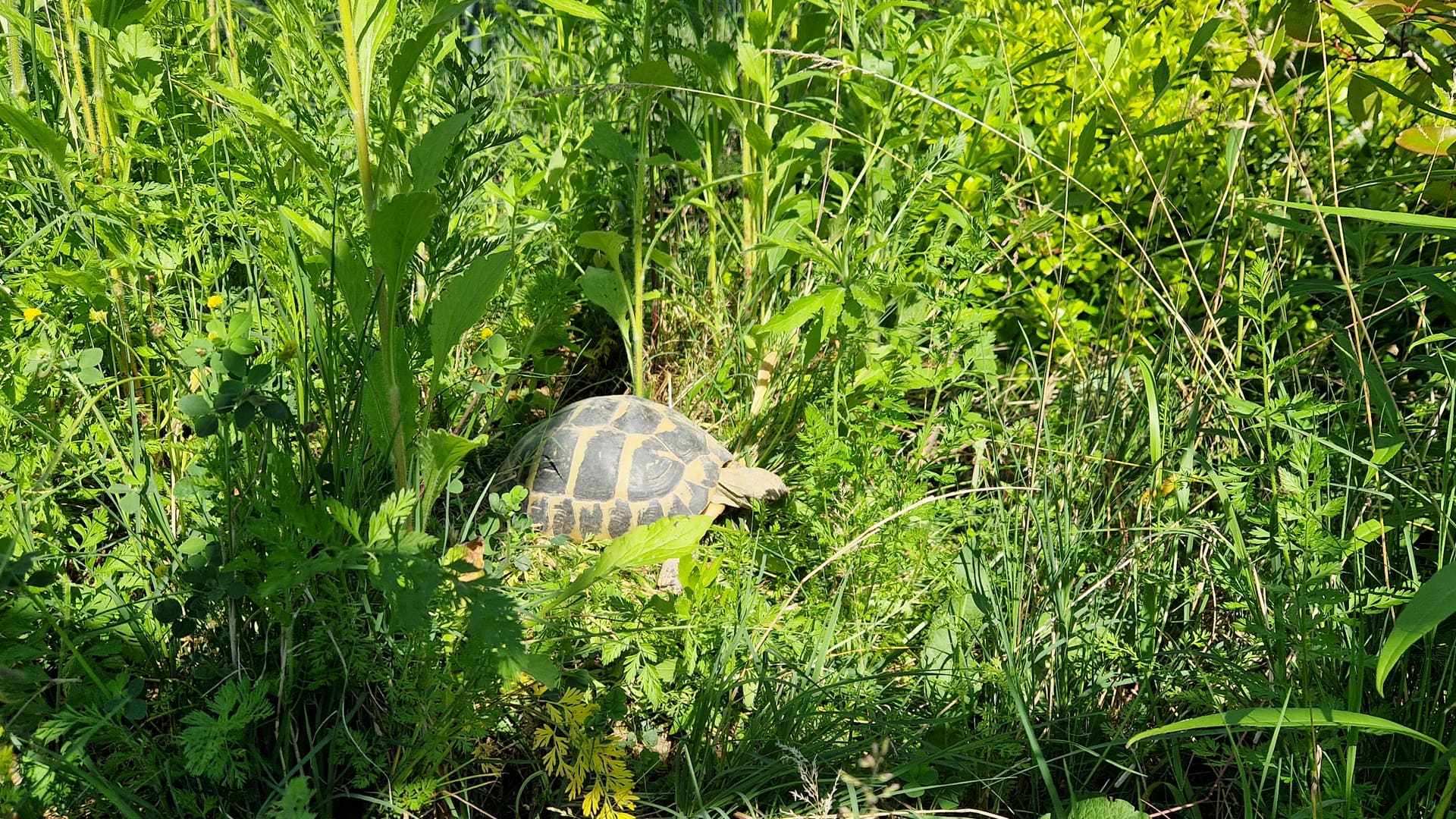
An authentic photograph from the Guardians’ archive: a glimpse of the habitat in use. It is not, on its own, a complete enclosure design.
An enclosure does more than prevent escape. It should give a tortoise a choice of different areas and protect it from hazards. Its design depends on species, size, climate and local conditions: a single measurement cannot show that the space is suitable.
Observe the space before building
Watch how sun and shade move throughout the day and across the seasons. Check where rainwater drains and where it collects. A pleasant corner in spring can become very hot in summer or flood in autumn. Design the enclosure for these changes, not just for the day you set it up.
The perimeter: every part must be checkable
- Consider digging, climbing and footholds near the edges.
- Check gates, joints, damaged mesh and gaps beneath protective barriers.
- Consider dogs, rodents and other animals in the area; familiarity does not remove the risk.
- For small individuals, consider overhead protection too, avoiding entrapment and overheating.
Do not add animals to fill a space that looks empty. You need to be able to separate incompatible individuals and manage a new arrival under an agreed health plan.
Inside the enclosure: a mosaic of choices
Ground conditions, suitable vegetation, shelters and varied areas create a richer habitat than a uniform surface. Sun and shade should be accessible without dangerous compulsory routes. Shelters need checking and should be kept dry where necessary, without indiscriminately removing every damp microhabitat.
Water should be stable and easy to reach. Avoid features that could tip over, trap an animal or cause a fall. Our archive photographs also show construction stages: not every visible feature is a finished solution to copy.
Simple, consistent maintenance
Before using a mower, strimmer or tools, locate all animals and make them safe using appropriate handling and care. Do not rely on them usually resting in the same place. After a storm or garden work, check the entire perimeter again.
A short private record can help: date, issue observed, action taken and follow-up check. Public photographs should not make the location where animals are kept identifiable.
